
Trumbull County property search by address helps users find accurate parcel details by entering a street address into official county records. This search method connects one location to one parcel, which keeps results clean and easy to read. It works well for tax checks, ownership review, and property research. Users get direct facts pulled from public real estate records.
Trumbull County property search by address gives clear results that match how properties are recorded in Ohio parcel systems. Street-based searches reduce errors tied to common owner names or spelling changes. The county property database links addresses to parcel records for consistency. This makes address lookup the preferred option for fast and reliable property details.
How to Search Property Records in Trumbull County Using an Address
A Trumbull County address lookup helps users find parcel records tied to a specific location through the county property locator. This method works best for users who want direct results linked to one property.
Searching by address uses exact address match logic inside the public property database. The system reviews street details, city or township data, and address variations before returning parcel records. Clear input leads to faster and cleaner results.
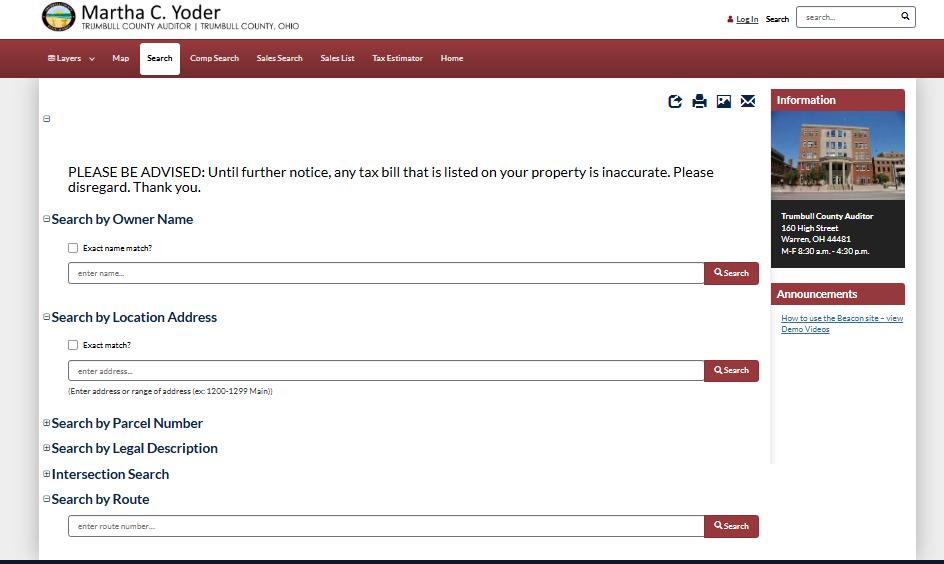
Steps Address Search Process
Each step below improves accuracy and limits empty or partial results.
1. Enter the street number
Start with the full street number listed on mail or tax documents. Avoid ranges or estimates. A single incorrect digit can block the match inside the property locator.
2. Use correct street name formatting
Street names should match county records. Spell the full name and avoid punctuation. For example, type “Mahoning Ave” rather than “Mahoning Avenue,” since many parcel records store shortened forms.
Helpful formatting tips include:
- Use standard street suffixes (St, Rd, Ave, Blvd)
- Skip punctuation marks
- Keep spacing clean between words
3. Select the correct city or township
Many streets appear in more than one area. City or township selection narrows the search filters and removes duplicate results. Trumbull County records rely on local boundaries to separate similar addresses.
If unsure, try nearby townships listed on tax bills or utility statements.
4. Review address validation prompts
The system may suggest address variations after entry. These prompts help match the exact address stored in parcel records. Users should review each suggestion before selecting one.
Address validation improves results by matching formatting used inside public real estate records. Small changes, such as removing extra spaces, often lead to a successful lookup.
Quick checklist before submitting:
- Street number present
- Correct suffix used
- City or township selected
- No extra symbols or punctuation
Common Address Search Errors to Avoid
Many failed searches trace back to simple input issues. Fixing these errors saves time and avoids confusion.
Abbreviations entered incorrectly
Some users spell out street types that the system stores in short form. Mixing “Drive” with “Dr” or “Road” with “Rd” can block exact address match logic.
Unit or apartment numbers included
Most parcel records list the main structure only. Unit numbers like “Apt 2B” or “Suite 300” should stay out of the address field. These details narrow the search too far and block results.
Rural route or P.O. box formatting
Rural routes and mailing boxes do not link directly to parcel records. The property locator relies on physical location data, not mailing addresses. Users should enter the street location assigned to the parcel.
Extra spacing or symbols
Double spaces, commas, or special characters interfere with search filters. Clean text improves matching inside the property database.
Error-prone entries to skip:
- “RR 2 Box 145”
- “123 Main Street, Apt 4”
- “45-B Elm St.”
Official Trumbull County Property Address Search Tools
Here are the official tools for a Trumbull County property address search, with accurate links to county sources. Each tool offers official parcel and tax data tied to an address, so users can find ownership, tax assessments, and GIS parcel maps directly from county systems.
Trumbull County Auditor Property Search
This tool is the main auditor database for detailed parcel and tax information. When a user enters a Trumbull County address, it returns official ownership records, assessed values, property class, and tax history tied to that address. The database matches to exact parcel records maintained by the county auditor’s office.
Official link (naked URL):
https://property.co.trumbull.oh.us/
What this tool shows:
- Owner name linked to the address
- Parcel number and assessment values
- Property tax amounts and history
- Legal and land description
This auditor database works best for verifying property address matches to official public records and tax assessment data.
Trumbull County GIS Mapping System
The GIS parcel map displays properties on an interactive map, which helps users see boundaries and land details tied to an address. An address search in the GIS system points to exact parcel shapes and adjacent parcels.
Official link (naked URL):
https://www.co.trumbull.oh.us/Auditor/GIS
Features to use:
- View parcel boundaries on a map
- Check property size and shape
- Zoom into specific neighborhoods
- See layers from aerial imagery to tax maps
Map tools help users confirm the visual layout of properties and locate exact parcels tied to an address.
Tax & Parcel Lookup Portals
The Trumbull County Treasurer’s Office doesn’t have a dedicated search tool for parcel records, but its site links to the county’s property search and tax info pages. Once a parcel is located through the auditor’s address search, users can view tax payment details here.
Official link (naked URL):
https://www.co.trumbull.oh.us/Treasurer/
What you can find here:
- Property tax due dates and payment options
- Billing amounts tied to a parcel
- Links to print tax bills or pay online via the auditor search results
How these official tools work together:
- Auditor property search provides parcel records and assessed values.
- GIS parcel map shows location, boundaries, and spatial context.
- Treasurer tax portal displays payment and tax billing details once a parcel is selected.
What Property Information You Can Find by Address
A location-based search shows detailed parcel info tied to one physical address. This method pulls official land records linked to a tax parcel, giving users clear facts about ownership, size, value, and land use.
Property data connected to an address stays consistent across county systems. A location-based search limits confusion and returns records tied to one parcel instead of multiple owners or names.
Ownership & Deed Details
An address search reveals ownership data recorded in county land records. These details show who holds legal title to the property and how that title changed over time.
Ownership records usually include:
- Current owner name on file
- Transfer dates tied to deeds
- Sale price from recorded transfers
- Type of deed used in each transfer
Deed details help confirm legal ownership and past sales tied to the address. Real estate professionals often rely on this data during title checks or pre-sale research. Each deed connects directly to the tax parcel linked to that location.
Parcel Number & Lot Size
Every property receives a unique parcel number. This number acts as the main identifier across county systems. A location-based search links the address to that parcel number instantly.
Parcel data often shows:
- Parcel number used for tax billing
- Lot size in acres or square feet
- Property boundaries defined by surveys
- Subdivision or plat references
Lot size details help buyers and planners review land dimensions without guessing. Parcel info supports boundary checks and land comparisons across nearby properties.
Property Tax & Assessment Values
Address searches connect directly to tax parcel data used for billing and valuation. These records display both assessed value and market value assigned by the county.
Common tax-related data includes:
- Assessed value used for taxation
- Market value estimate from the auditor
- Annual property tax amount
- Payment status and billing year
Assessed value reflects taxable worth, not sale price. Market value reflects an estimate based on local sales and trends. Tax parcel records help property owners track valuation changes over time.
Zoning & Land Use Information
Zoning data outlines how land may be used under local rules. A location-based search links the address to zoning codes stored in county land records.
Zoning and land use details may show:
- Residential, commercial, or agricultural zoning
- Permitted building types
- Lot coverage limits
- Special land use notes
Land use records support planning and development decisions tied to the parcel. Address-based searches give users reliable zoning data without sorting through unrelated properties.
Searching Property by Address vs Owner Name in Trumbull County
A property search by address vs owner compares two common ways to find parcel records in Trumbull County. Each method serves a different purpose, though address-based searches usually return more precise results.
Both options pull data from county land records. The difference lies in how narrowly each search connects to a single tax parcel.
Accuracy Comparison
Searching by address ties results to one physical location. Each address links to one parcel number in county systems. This structure limits duplicate records and reduces confusion.
Owner name searches work across many parcels. A single name may appear on several properties. Common surnames increase result lists and raise the chance of mismatches. Spelling variations and shared ownership can further complicate results.
For accuracy, address searches rank higher. They rely on fixed location data stored in parcel systems. Owner name searches rely on personal identifiers that change more often.
Accuracy summary:
- Address search: High accuracy, single parcel focus
- Owner name search: Lower accuracy, multiple results common
When an Address Search Works Best
Address searches fit users who already know the property location. Buyers often start with an address from a listing. Inspectors and appraisers follow the same path. County systems match that address to parcel info without extra filtering.
Address searches also support:
- Tax checks tied to a known location
- Zoning and land use review
- Boundary and lot size checks
This method works well for quick answers linked to one property.
Common Use Cases by Role
Different users rely on different search types based on goals.
Home buyers: Buyers use address searches to review tax history, assessed value, and parcel size before offers.
Real estate lawyers: Legal professionals use address searches during title reviews. One address links directly to deed records and transfer history.
Investors: Investors prefer address searches when analyzing a target property. This keeps research focused on one tax parcel.
Who Uses Trumbull County Address-Based Property Searches?
Trumbull County address-based property searches serve many user groups with clear, location-focused needs. These searches support intent-based search scenarios where users want fast, accurate parcel data tied to a single address.
Address-based searches work best when the location is known. Each group below uses this method for different goals tied to land records and tax parcels.
Homebuyers
Homebuyers rely on address searches during early research. A known street address links straight to parcel info, assessed value, and tax history. This helps buyers compare costs before making offers.
Typical homebuyer goals include:
- Checking assessed value and market value
- Reviewing property tax amounts
- Confirming lot size and parcel boundaries
Clear address results help buyers avoid confusion tied to similar owner names.
Property Owners
Property owners use address searches to review their own records. Many check tax parcel data during billing periods or valuation reviews.
Common owner uses:
- Verifying assessed value changes
- Reviewing payment history
- Confirming deed records tied to the address
Address searches keep owners focused on their exact property.
Real Estate Investors
Investors often analyze one target property at a time. Address-based searches support quick checks tied to location-based search needs.
Investor use cases include:
- Reviewing land records before purchase
- Comparing nearby parcel values
- Checking zoning tied to future use
This method keeps analysis focused and efficient.
Attorneys
Attorneys use address searches during legal reviews. One address links to deed transfers, ownership records, and parcel identifiers.
Legal scenarios include:
- Title review
- Property disputes
- Estate-related parcel checks
Address-based results reduce record overlap during case work.
Researchers
Researchers analyze property trends tied to location. Address searches help track land use patterns and parcel changes over time.
They often review:
- Parcel size trends
- Assessment history
- Zoning changes by area
Tax Professionals
Tax professionals rely on address searches during filing and review work. Each address links directly to a tax parcel used for billing.
They check:
- Assessed value accuracy
- Market value changes
- Tax payment records
FAQs – Trumbull County Property Address Lookup
These FAQs answer common questions about Trumbull County property address lookup tools. Each response focuses on clear, location-based facts pulled from official parcel and land records.
Is Trumbull County property search free?
Yes. Trumbull County offers free public property search tools. Users can view parcel records, ownership data, assessed value, and tax parcel details without fees. County offices publish these records to support public transparency. No account setup or payment is required for basic address searches. Some services, such as certified copies, may involve fees handled by county offices, though basic lookup features remain free.
Can I search by partial address?
Partial address searches work in limited cases. Entering only a street name may return multiple parcels tied to that road. This approach fits users browsing properties within one area.
For better results, users should include:
- Street number
- Street name
- City or township
Partial entries reduce exact address match accuracy. Full address input narrows results to one tax parcel tied to that location.
How accurate are parcel records?
Parcel records in Trumbull County reflect official land records used for taxation and legal reference. County offices maintain these records based on deeds, surveys, and assessment updates.
Accuracy remains high for:
- Parcel boundaries
- Ownership names on file
- Assessed value used for tax billing
Market value reflects county estimates rather than sale price. Small timing gaps may appear after recent sales or transfers, though core parcel info stays reliable.
How often are records updated?
Update schedules vary by record type. Ownership changes post after deed recording. Assessment values update during scheduled county review cycles.
Typical update timing includes:
- Deeds: posted after recording
- Ownership names: updated after transfer review
- Assessed value: adjusted during reappraisal cycles
Tax parcel balances update after payments post. Recent transactions may take several days to appear in public systems.
Can I find property tax balance by address?
Yes. Address searches link directly to tax parcel records used by the county treasurer. Once the parcel appears, users can view current balances and payment history.
Tax data usually includes:
- Current amount due
- Prior payments
- Delinquency status
Mailing addresses do not link to tax parcels. Street location input works best for balance review.
What if an address doesn’t return results?
Several issues may block results. Minor input errors often cause search failures.
Common fixes include:
- Removing unit or apartment numbers
- Using standard street abbreviations
- Checking city or township selection
- Trying slight address variations
New construction properties may not appear yet. Rural route addresses often fail since parcel systems rely on physical location data. Checking tax bills or recorded deeds often reveals the correct parcel address.